Hiring for Workday is a strange market. The platform runs HR and finance for more than 10,000 organizations, yet the pool of people who can actually configure it is small, certified through Workday's own partner channels, and heavily recruited. If you have just signed with Workday, inherited a messy tenant, or watched your one in-house expert hand in their notice, you have probably already discovered how thin the talent pool feels.
This guide covers what the different Workday roles actually do, what they cost in 2026, and how to run a hiring process that lands someone good before a competitor does.
First, know which role you actually need
"Workday consultant" is an umbrella term that hides four very different jobs. Posting the wrong one is the fastest way to attract the wrong applicants.
Functional consultants
These are the people who configure Workday to match your business processes. They specialize by module: HCM, Payroll, Benefits, Compensation, Absence, Talent, Recruiting, or Financials. A functional consultant translates "our approval chain works like this" into business process definitions, condition rules, and security groups. Most companies need this role first.
Integration and technical consultants
Workday rarely lives alone. Integration consultants connect it to your payroll providers, benefits carriers, ERP, and identity systems using Workday Studio, EIB, Core Connectors, and web services. If your project involves moving data in or out of Workday, you need this skill set, and it commands developer-level pay.
Reporting and analytics specialists
Advanced reporting, calculated fields, dashboards, and Prism Analytics. Often bundled into a functional role at smaller companies, but a dedicated specialist pays for itself once leadership starts asking for people analytics.
Solution architects and deployment leads
Senior people who own the whole tenant design, manage workstreams, and keep an implementation partner honest. On a new deployment or a major Financials rollout, an experienced architect on your side of the table is the difference between a launch and a rescue project.
Contract or permanent?
The rule of thumb most Workday clients settle on: contract for projects, permanent for ongoing support.
Implementations, module rollouts, and open enrollment crunches have a defined end date, which makes a contractor's higher hourly rate easier to justify. Day-to-day tenant maintenance, release testing twice a year, and the steady stream of business-as-usual tickets are better served by a permanent hire or a managed-services arrangement who builds knowledge of your specific configuration over time.
Plenty of teams do both: a permanent analyst who knows the business, plus contractors brought in for the heavy lifts.
What Workday consultants cost in 2026
Salary surveys put the average US Workday consultant at roughly $108,000 a year, but that average hides a wide spread. Junior analysts start around $70,000 to $95,000, experienced functional consultants land between $100,000 and $175,000 depending on seniority, and solution architects with nine or more years in the ecosystem clear $170,000 to $230,000 and up. Integration specialists sit toward the top of each band because they compete with the broader developer market.
Contract rates follow the same pattern, with a premium for flexibility:
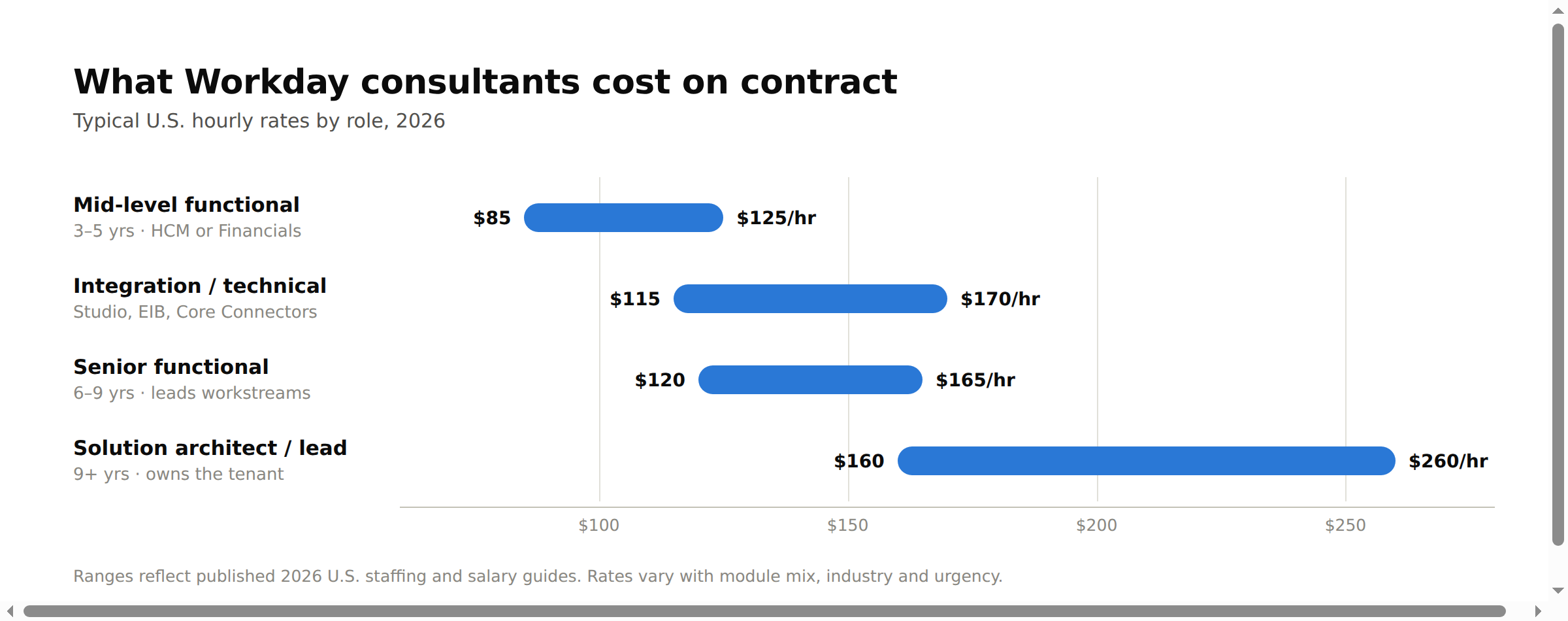
Three things push rates up quickly: scarce module combinations (Payroll plus Absence, or Financials plus Prism), industry experience that matches yours, and urgency. If you need someone to start Monday, expect to pay for it.
One more budget note: a good independent contractor sourced directly often costs less per hour than the same person billed through a large consultancy, where agency margin can add 30 to 50 percent on top.
Where to actually find them
Generic job sites are where Workday postings go to drown. The role titles overlap with thousands of "Workday experience a plus" listings, so the specialists have mostly stopped looking there.
What works better:
Specialist job boards. Boards dedicated to the Workday ecosystem put your posting in front of people who already work in it, including the passive candidates who only browse roles in their niche. That is exactly why we built WD Talent Hub: employers can post a Workday role and reach consultants, analysts, and architects rather than a general audience.
Your implementation partner's alumni. Many of the best independent consultants spent their first years at a Workday partner firm. Ex-partner consultants combine formal certification with real deployment scars.
Community referrals. The Workday world is small. Ask your current team, your partner contacts, and user groups who they would hire again. A warm referral routinely beats fifty cold applications.
How to screen without being a Workday expert yourself

You do not need deep product knowledge to filter well. You need to verify three things.
Real tenant experience. Ask which tenants they have worked in, what they configured, and what went wrong. Someone who has only completed training exercises talks in generalities. Someone with real experience tells you about the payroll parallel test that failed at 11pm and what they did about it.
Certification status. Active Workday certifications are held through employment with Workday or a partner, so independent contractors are often "previously certified" rather than currently certified. That is normal and not a red flag by itself, but you should know which one you are getting, and for architects on partner-led projects, current certification can matter contractually.
A scenario, not a quiz. Describe a real problem from your own tenant and ask how they would approach it. You are listening for clarifying questions, trade-offs, and awareness of downstream effects on security, reporting, and integrations. Strong consultants ask you questions before proposing answers.
If nobody on your team can evaluate the answers, borrow an hour from a senior consultant you trust, or your partner's engagement manager, and have them sit in on the final round.
Plan for a five or six week process
Good Workday people are rarely on the market longer than a couple of weeks, so the process needs to be tight. Here is what a realistic timeline looks like when it runs well:
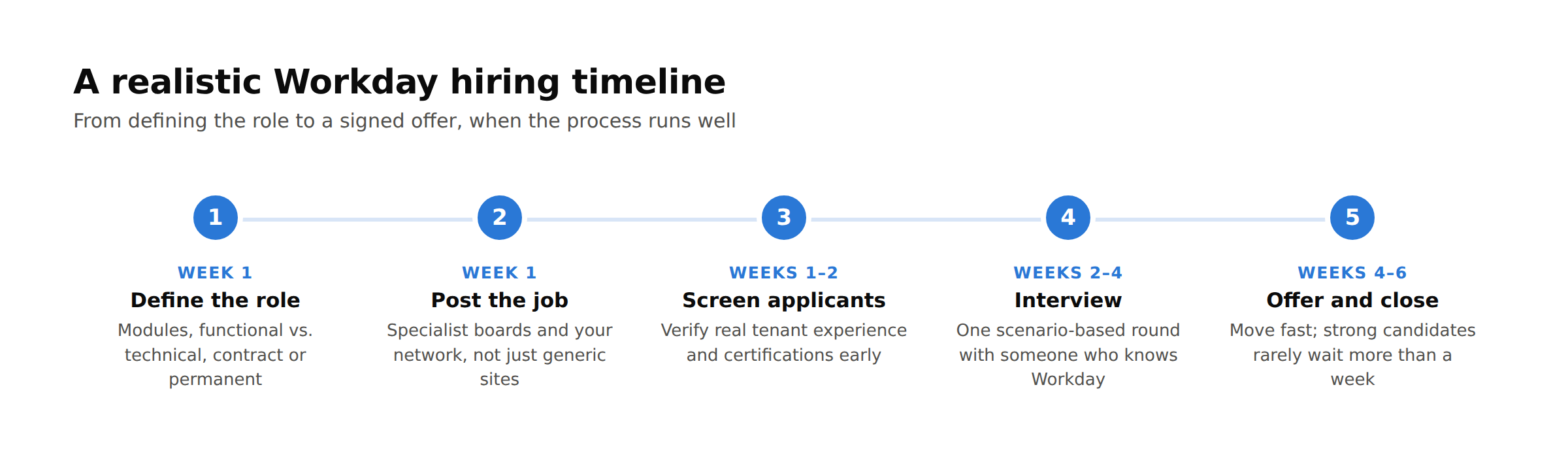
The step that kills most searches is the gap between interviews and offer. If your approval chain takes three weeks to sign off, the candidate has usually accepted something else. Get budget and approvals lined up before you post, and when you find the right person, move.
Mistakes we see employers make
A few patterns come up again and again in the roles posted on our board and the conversations behind them.
Asking one hire to cover everything is the most common. A posting that wants HCM configuration, Studio integrations, advanced reporting, and payroll support is describing two or three people, and experienced candidates skip it because they know the job is a trap. Scope the role to what one person can genuinely own.
Underestimating the release cycle is another. Workday ships two major releases a year, and testing them is real work. If your support model has no capacity for it, March and September will hurt.
And finally, hiring on price alone. The difference between a $95 an hour consultant and a $150 an hour consultant is often that the second one has already made, and learned from, the expensive mistakes. On anything touching payroll or financial close, cheap can get very costly.
Frequently asked questions
How much does a Workday consultant cost per hour?
In the US in 2026, typical contract rates run from about $85 an hour for mid-level functional consultants to $260 an hour for senior solution architects. Integration specialists usually fall between $115 and $170.
Do Workday consultants need to be certified?
Certification is only available through Workday and its partners, so many excellent independent consultants are previously certified rather than currently certified. Verify the history and weigh it alongside real project experience.
Should I hire a contractor or a full-time employee?
Use contractors for defined projects such as implementations, module rollouts, and integrations. Hire permanently for ongoing tenant administration and support, where continuity and institutional knowledge matter more than raw seniority.
How long does it take to hire a Workday consultant?
Four to six weeks is realistic for a well-run search on a specialist channel. Add several weeks if you are searching on generalist job sites, and be ready to move quickly at offer stage because strong candidates rarely wait.
Ready to hire?
When you are ready to put your role in front of people who live and breathe Workday, post it on WD Talent Hub. Your listing goes straight to a community of Workday consultants, analysts, and architects across every module, without the noise of a general job board.